
By Lucía Marín
Guide reviewed under editorial standards
This experience is structured to provide an itinerary, local context, transport, recommended season and mistakes to avoid. See how we review guides
How to make the most of this experience
Useful planning notes for 48 Hours In Seville: Alcázar, Triana And Flamenco With Judgement with a Destinations lens, especially if you are travelling with limited time or staying nearby.
Recommended duration
Between half a day and two days, depending on your pace and the stops you add.
Best season
Winter and cooler days, with layers and shorter daylight hours in mind.
How to get around
Prioritise public transport and walking sections; avoid moving the car between nearby stops.
Best for
First-time visitors, couples, apartment-based travellers and weekend breaks.
Accessibility
Check slopes, cobbles and real walking distances before closing the route.
Estimated budget
Medium: combine free visits with one or two well-chosen paid entries.
Keep the most demanding visit for the morning and leave the afternoon for walks from your stay.
Trying to see everything in one day and ending up jumping from photo to photo.
Seville is far more than the capital of Andalusia — it is the soul of Southern Spain, a city where every stone holds centuries of history and every sunset smells of orange blossom and promise. While most travellers rush to the Giralda tower and the imposing Cathedral, the true magic of the city reveals itself in the narrow, winding lanes of the Santa Cruz quarter at dusk, when the shadows stretch long and the distant echo of a flamenco guitar blends with the laughter of Sevillanos in the neighbourhood tabernas.
This guide is not a catalogue of monuments but an invitation to feel Seville the way those who live there feel it: to wander without a plan, to pause in a hidden courtyard, to taste a salmorejo at a centuries-old bar, to let yourself be seduced by an improvised soleá. Seville gives itself slowly, but once it does, you never forget it.
The legacy of the Real Alcázar
Few places in Europe pack so much history into so little space as the Real Alcázar. Built on the site of an old Visigothic fort, transformed by the Almohad caliphs, and reinterpreted century after century by Christian monarchs, this palace is a living lesson in architecture. Crossing the Puerta del León feels like stepping into a world where horseshoe arches coexist with Mudéjar coffered ceilings and Renaissance gardens make their way among centuries-old orange trees.
The Patio de las Doncellas is probably the most photographed corner of the palace, and for good reason: the mathematical precision of its tilework, the delicacy of its plaster carvings, and the serenity of its central pool make the visit feel almost meditative. It's worth arriving first thing in the morning, the moment the doors open, to enjoy the silence before the tour groups pour in.
The Alcázar gardens deserve an entire morning. Among myrtle hedges, baroque fountains, and Renaissance pavilions, it's easy to lose track of time. Many visitors will recognise these gardens from the television series filmed here, but the real enchantment goes far beyond fiction: peacocks strut with regal indifference, the palace cats doze in the shade, and the air smells of damp earth and jasmine.
Santa Cruz: the enchanted labyrinth
Right next to the Alcázar lies the Santa Cruz district, the old Jewish quarter and, without doubt, the most romantic heart of Seville. Its streets are so narrow that in some stretches two people can barely pass shoulder to shoulder, and the whitewashed façades contrast with overflowing pots of geraniums and bougainvilleas. Getting lost here isn't a risk: it's a plan.
Between one plaza and the next, unexpected corners appear. Plaza de Doña Elvira, with its orange trees and ceramic benches, is a perfect spot to sit and listen to the tablaos rehearsing as the day winds down. Plaza de los Venerables hides one of the most beautiful Baroque courtyards in the city, and the Callejón del Agua evokes Washington Irving, who lived there during his Sevillian years.
When aperitif hour approaches, follow the sound of forks and laughter. The neighbourhood tabernas serve snails in summer, cazón en adobo (marinated dogfish) year-round, and an icy fino sherry that, under the Andalusian sun, tastes like pure blessing.
The Giralda and the Cathedral: stone upon stone
It's impossible to speak of Seville without stopping at its cathedral, the third largest in Christendom and one of the great masterpieces of European Gothic. Built on the site of the old Almohad mosque, the Cathedral of Santa María de la Sede impresses with its monumental proportions but also with its details: the choir's stained glass, the grille of the main altar, the tomb of Christopher Columbus held aloft by the four kingdoms of Spain.
The Giralda, its bell tower, was once the minaret of the mosque. The Christian architects wisely preserved it, adding a Renaissance bell chamber topped with the Giraldillo, a weathervane that has been spinning with the wind for centuries. Climbing the Giralda is unique: instead of stairs there are ramps, originally designed so that the muezzin could ride up on a mule. From the top, Seville unfolds like a tapestry of rooftops, palm trees, and towers.
Triana: the other side of the river
Crossing the Triana bridge, the city's rhythm shifts. This is where Sevillian flamenco was born, where the ceramic tiles that decorate palaces across Spain were crafted, and where life is lived with a mix of working-class pride and contagious joy. Triana is the sailors' quarter, the gypsy quarter, the bullfighters' quarter; in many ways, it is the most authentic heart of Seville.
Walking along Calle Betis at sunset, with golden light reflecting on the Guadalquivir and the silhouette of the Torre del Oro in the distance, is one of those experiences that stays with you. The riverfront restaurants serve pescaíto frito (fried small fish) and cold manzanilla sherry, and as night falls, it's not unusual to stumble upon a group of friends who, without warning, break into a spontaneous bulería.
For anyone interested in ceramics, the Centro Cerámica Triana tells the story of how this neighbourhood became the official supplier of tiles for palaces and convents for centuries. Even today you can find artisan workshops where pieces are hand-painted with the same patterns that decorate the Alcázar.
Plaza de España: the iconic postcard
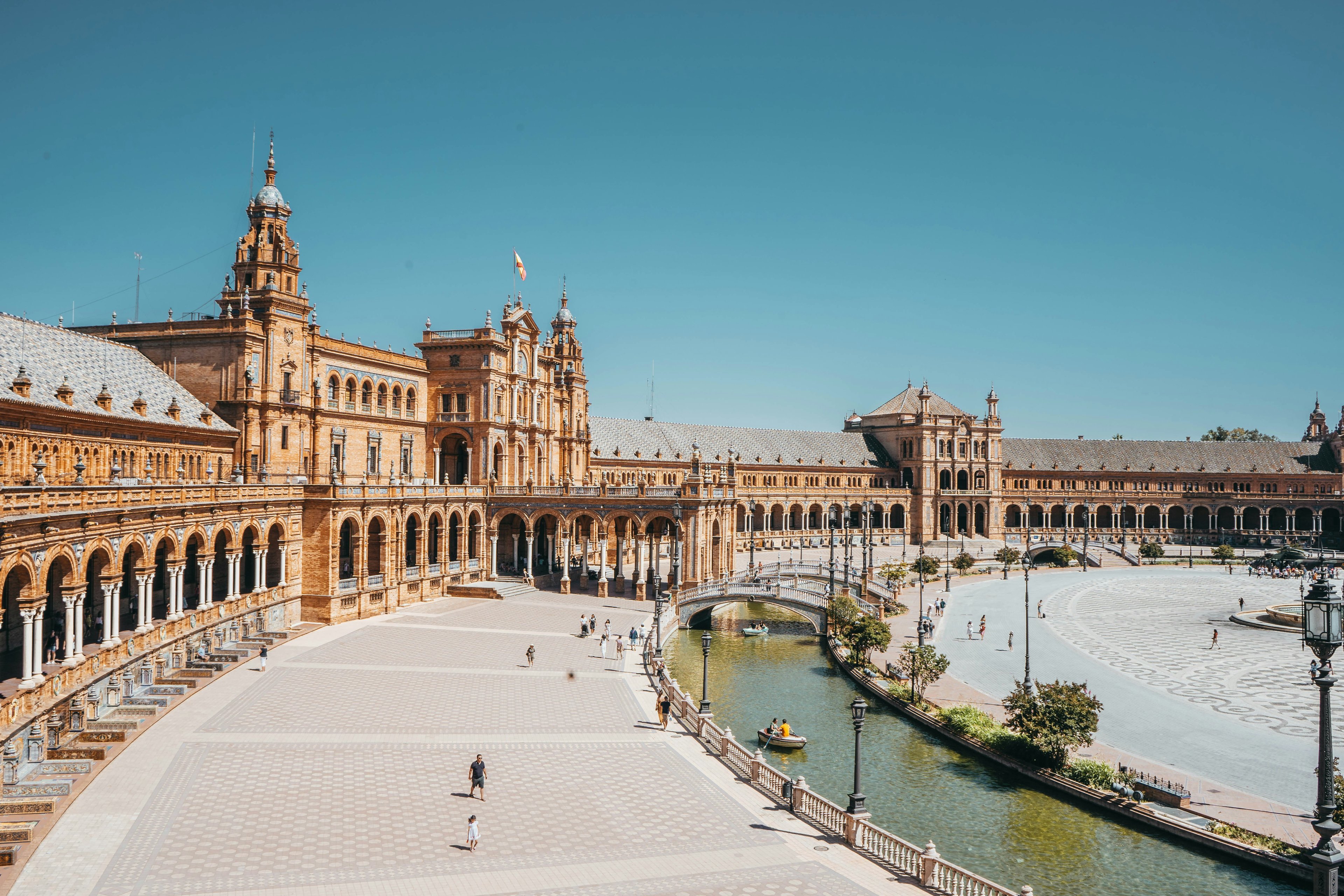
Built for the 1929 Ibero-American Exposition, Plaza de España is one of the most photogenic architectural pieces in the world. Its semicircular shape, twin towers, four bridges symbolising the ancient kingdoms of Spain, and ceramic-tiled benches dedicated to each Spanish province make it an essential stop.
Early in the morning or just before sunset, the plaza transforms. The reflections in the artificial canal, the sound of horses' hooves pulling the traditional carriages, and the little stalls where you can rent rowing boats all make you feel like the protagonist of an old film. Walking around the plaza is a must: each province has its own tiled bench with maps and scenes — a collective tribute to Spain's diversity.
María Luisa Park
Next to Plaza de España stretches María Luisa Park, an oasis of shade and fragrance in the middle of Seville's heat. Donated to the city at the end of the 19th century by the Infanta María Luisa, the park was redesigned for the 1929 Exposition by the French landscape architect Jean-Claude Nicolas Forestier, the same man who worked on the Champ de Mars in Paris.
Along its paths hide small plazas dedicated to Spanish poets, duck ponds, tiled benches, and a blend of vegetation that mixes palm trees, magnolias, and roses. It's the Sevillanos' favourite spot for a Sunday picnic, and a perfect retreat when your legs can't take another monument.
Culinary pilgrimage
Seville is one of Spain's great culinary capitals — not because of pretentious menus, but because of the quality of its produce and the wisdom of its traditional cooks. Tapeo here is an art, a social ritual, and often an entire dinner on its own.
Start your journey with a salmorejo at a centuries-old taberna like Casa Morales or Las Teresas: thick, cold, topped with chopped hard-boiled egg and slivers of Iberian ham. Move on to espárragos con huevo near Plaza del Salvador, try the solomillo al whisky at El Rinconcillo (the oldest taberna in the city, operating since 1670), and finish with tortillitas de camarones (shrimp fritters) in Triana, washed down with a very cold manzanilla.
Don't leave without tasting the yemas de San Leandro, still made by the nuns of the convent of the same name. The sisters sell the sweets through a lazy Susan, never showing their faces — a fragment of medieval Seville that survives in the 21st century.
Flamenco: the pulse of the city
Talking about Seville without mentioning flamenco would be like talking about Vienna without mentioning classical music. Here flamenco isn't a tourist spectacle; it's a way of understanding the world. From the better-known tablaos like Los Gallos in Santa Cruz or El Arenal near the river, to the small cafés cantantes of Triana, the options are endless.
If you want a more authentic experience, ask about the peñas flamencas — associations where amateurs and professionals gather to sing without script or schedule. They're less touristy, more intimate, and they offer an unfiltered view of flamenco. The Bienal de Flamenco, held every two years in September, is a must for true aficionados.
When to visit: Feria and Semana Santa
Seville has two moments in the calendar when it becomes a different city. The first is Semana Santa (Holy Week), when the brotherhoods parade their pasos (religious floats) through the streets for a whole week, in processions that blend religious devotion, Baroque art, and raw popular emotion. Watching a dawn procession from the Triana bridge is an experience that moves even the least religious visitor.
The second is the Feria de Abril, held a week after Semana Santa. For six days and six nights, Seville moves to a fairground filled with casetas (tents), paper lanterns, and flamenco dresses. People dance sevillanas, drink rebujito (manzanilla mixed with lemonade), and eat pescaíto frito until the early hours. The Feria is less accessible to visitors than Semana Santa, as most casetas are private, but wandering through the grounds is enough to grasp the festive spirit of the city.
Practical tips
Getting around Seville is easy: the historic centre is small and walkable. The metro and buses are efficient, but for short trips the public bicycle system (SEVici) is an unbeatable option. Combined tickets that bundle the Cathedral, Alcázar, and other monuments can save time in summer, when the queues stretch long.
Seville's climate is continental Mediterranean: mild winters, glorious springs, very hot summers (40 °C in August is standard), and luminous autumns. The best times to visit are March, April, May, October, and November. In peak summer, plan your visits for first thing in the morning or late afternoon, and dedicate the central hours to a siesta or to air-conditioned museums.
Finally, one piece of Sevillano advice: don't try to squeeze Seville into a lightning visit. The city demands at least three days, four if you can spare them. The more you surrender to its unhurried rhythm, the more it will give back to you in magic, flavour, and memory.
A city that stays with you
Many travellers arrive in Seville expecting a museum-city and leave feeling they've discovered an emotion-city. Because Seville, beyond its monuments and history, is above all a sensory experience: the smell of orange blossom in March, the cool touch of a ceramic tile at midday, the taste of a well-poured fino, the sight of a horse crossing the Triana bridge at dusk, the sound of a guitar that starts playing without anyone quite knowing where it came from.
You don't visit Seville. You feel it. And once you've felt it, you're never quite the same again.
A Smart 48-Hour Plan
A balanced day in Seville works best like this: in the morning, enter the Alcázar or Cathedral with a booking before the strongest heat; around midday, eat in Santa Cruz only if you have chosen carefully; otherwise move toward Arenal or Alfalfa; in the afternoon, take a real pause and return with the river or Triana; at sunset, look for the Guadalquivir bank or a bridge before dinner; and at night, close with Triana, Alameda or a flamenco venue chosen with judgement, not by slogans. The point is not to fill every minute, but to avoid the most common friction points: heat, queues, long transfers and meals chosen when everyone is already tired.
How To Order The Route Without Backtracking
Think of the experience as a simple line: Alcázar, Cathedral, Santa Cruz, river, Triana and a neighbourhood night. This mental map helps you decide what to skip if the day gets slower than expected. A good itinerary is not the one that covers the most places, but the one that keeps the route coherent and gives each stop enough time to be remembered.
Best Base For Staying Overnight
If you sleep in an apartment, check shade, air conditioning and real walking distance. In Seville, 20 minutes under July sun are not the same 20 minutes shown on a map.
Three Choices That Can Spoil The Trip
Do not visit the Alcázar and Cathedral without tickets; do not fill an August afternoon; and do not buy “authentic flamenco” just because a sign says so.
When To Go And How To Move Around
Spring and autumn are magnificent; summer requires early starts, rest and night life; winter is mild and very comfortable for walking. For transport, choose the simplest connection back to your lodging before adding extra stops. For accessibility, reduce cobbled streets, steep climbs or long beach approaches when travelling with children, older guests, wheelchairs or heavy luggage.
Where To Eat Beyond The Obvious
Eat with judgement by alternating bar tapas in neighbourhoods, a seated lunch when it is hot, and areas such as Triana, Feria, Arenal or Alfalfa depending on the atmosphere you want.
Common questions before you go
Quick answers to decide whether 48 Hours In Seville: Alcázar, Triana And Flamenco With Judgement fits your trip and how to plan it with a Destinations lens.
How much time should I set aside for 48 Hours In Seville: Alcázar, Triana And Flamenco With Judgement?
A half day is the sensible minimum. If it is your first visit, leave time to walk slowly and add a proper meal or rest stop.
What is the best season for this experience?
It works year-round, but spring and autumn usually offer the best balance of weather, light and crowds.
What is the best way to get around?
Combine public transport with short walks. Moving a car between central stops usually costs more time than it saves.
What is your advice if I am staying nearby?
Use the proximity to split the plan in two: the main visit in the morning and a freer walk late in the day.
What mistake should I avoid?
The most common mistake is trying to see everything in one day. Choose a coherent route and leave something for another time.
Operating a Rental in this area?
Stay fully compliant with Spain's strict tourism regulations. HazCheckin automates your guest registration and legal reporting directly to Spanish authorities.